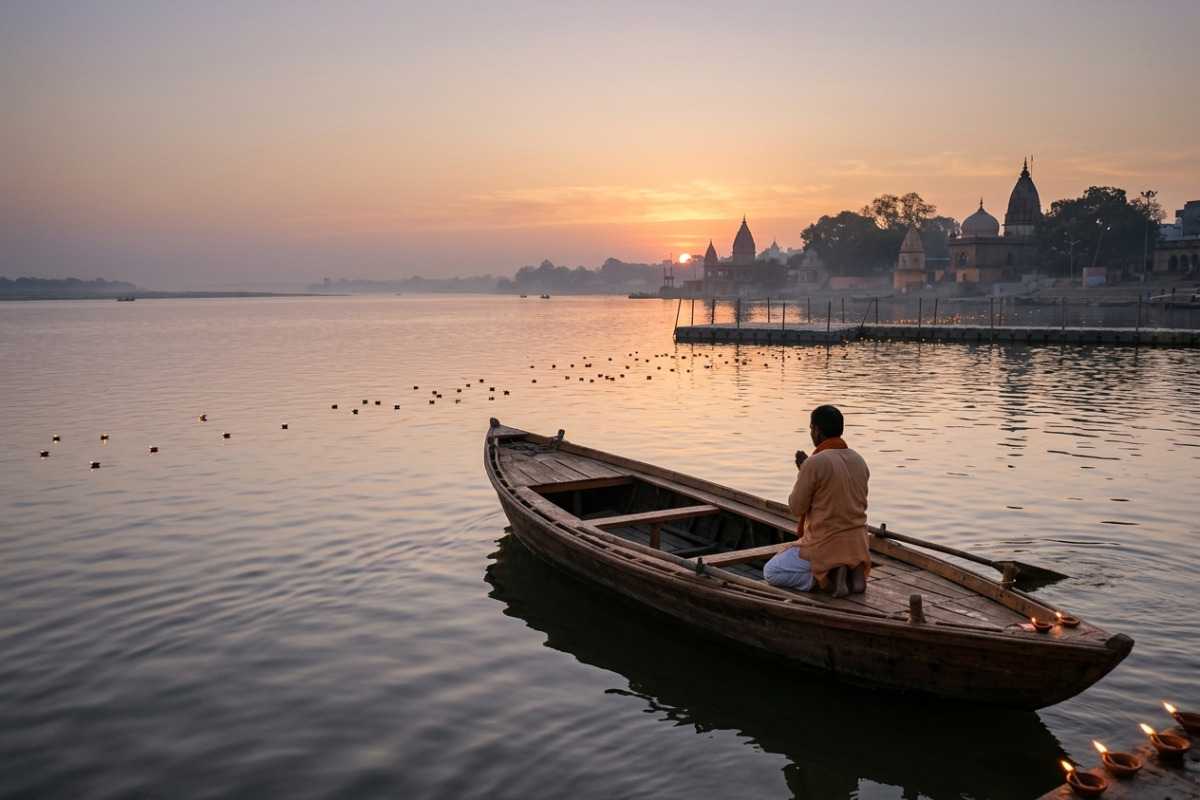
Boat Ride to the Triveni Sangam
Glide out across the river at the break of dawn to reach the exact point where the Ganga and Yamuna meet. Watch the waters swirl and shift colour — one green, one ochre — into a single flowing whole.
At the sacred confluence of the Ganga, Yamuna, and the mystical Saraswati lies one of the world's most spiritually significant cities. Come to Prayagraj — and find something timeless.
Prayagraj — known to the ancient world simply as Prayag — sits at the Triveni Sangam, the point where the Ganga and the Yamuna visibly meet and the mythical Saraswati is said to flow unseen beneath. For thousands of years, pilgrims have travelled here to bathe at this confluence, believing it washes away every sin accumulated across many lifetimes.
But this is also a city that has witnessed empires rise and fall — from the Mauryas to the Mughals to the British — and a city that shaped modern India. Allahabad Fort, Anand Bhawan, Khusro Bagh: layers of a rich, complex history laid over an even older spiritual landscape.
Read the City Guide →Few destinations on earth carry the weight of history, faith, culture, and daily life in such close, everyday balance.
The Triveni Sangam is considered Hinduism's holiest confluence. Bathing here carries a significance few places in the world can match.
From Ashoka's edicts to Akbar's fort to the birthplace of India's independence movement — every era left something remarkable behind.
The ghats at dawn are among India's most atmospheric experiences — quiet, meditative, and visually arresting in a way photographs cannot fully capture.
Allahabad University, the literary traditions of Hindi literature, the old city's food — Prayagraj has a cultural life well beyond its spiritual fame.
Glide out across the river at the break of dawn to reach the exact point where the Ganga and Yamuna meet. Watch the waters swirl and shift colour — one green, one ochre — into a single flowing whole.
As dusk falls over the Yamuna Ghat, priests perform the Ganga Aarti with fire, incense, and ancient hymns. The reflection of oil lamps on the river surface is a sight that stays long after you have returned home.
The lanes of Chowk and Loknath offer some of North India's finest street food — kachori, puri-chhole, chaat, and the city's legendary chhena toast — alive with colour and flavour at dusk.
A curated selection of services to help you plan, book, and travel more easily.
Compare hotels, guesthouses, and dharamshalas near the Sangam and Civil Lines.
Search Hotels →Prayagraj Airport connects to Delhi, Mumbai, Bengaluru, and other major cities.
Compare Flights →Get a data-only eSIM for India with solid 4G/5G coverage before you depart.
Get an eSIM →Sunrise boat tours, heritage walks, and day trips with knowledgeable local guides.
Browse Tours →What makes the meeting of rivers a spiritual act? We trace the ancient logic behind the Triveni Sangam's enduring power.
A practical guide to attending the Kumbh — key dates, where to stay, and how to navigate the sacred grounds.
From Loknath's famous chaat to tehri and doodhwali chai — a street-level food guide to the city's most authentic flavours.
October to March is ideal. Temperatures are comfortable (15–28°C), the Ganga's water level is pleasant for bathing, and the city is at its most welcoming. Avoid May and June when temperatures regularly exceed 45°C.
The Sangam is about 7 km from Prayagraj Junction station. Auto-rickshaws and e-rickshaws make the journey regularly. Once at Sangam Ghat, hire a boat — the cost is typically ₹100–₹300 per person. Most visitors prefer an early morning visit between 5 and 8am.
Two days is the practical minimum to cover the Sangam, the fort, Anand Bhawan, and the old city. Three days allows for a relaxed, deeper exploration including the museum, Khusro Bagh, the university area, and a proper food trail.
Modest dress is expected at all temples and sacred sites. Shoulders and knees should be covered. Remove footwear before entering temples. Many visitors carry a lightweight scarf which doubles as sun protection at the riverbank.
Prayagraj is generally considered safe for tourists, including solo travellers. The city has a strong pilgrim culture which creates a broadly respectful atmosphere. As with any large Indian city, keep belongings secure in crowded areas.